What are the Seven Pillars
The Return to Self Framework
Welcome Coming Home to Yourself.
There are moments in life that change us forever.
Sometimes they arrive through joy.
Sometimes through heartbreak.
Sometimes through illness.
And sometimes life simply asks us to stop.
For me, that moment came when my body could no longer keep up with the life I had been asking it to carry.
Compression fractures in my spine forced me to slow down in a way I had never allowed myself before.
At first, I thought my recovery would be about healing my back.
Instead, I discovered I was healing much more than that.
As I slowed down, I began asking different questions.
Not...
"How quickly can I get back to normal?"
But...
"How did I get so far away from myself?"
Those questions became the beginning of Return to Self.
How the Seven Pillars Came to Be
The Seven Pillars weren't designed around a business model or created in a weekend workshop.
They emerged quietly through lived experience.
Over the months that followed, I found myself writing almost every day.
Reflecting.
Learning.
Listening.
Observing my body.
Exploring psychology, physiology and neuroscience.
Studying nutrition.
Returning to movement.
Deepening relationships.
Finding stillness.
Questioning old beliefs.
As I looked back over my journal, one pattern became impossible to ignore.
Every meaningful shift in my wellbeing could be traced back to the same seven foundations.
Whenever one felt out of balance, the others were affected.
When one became stronger, it naturally supported the rest.
The pillars weren't something I invented.
They were something I recognised.
They became a map that helped me understand my own journey home.
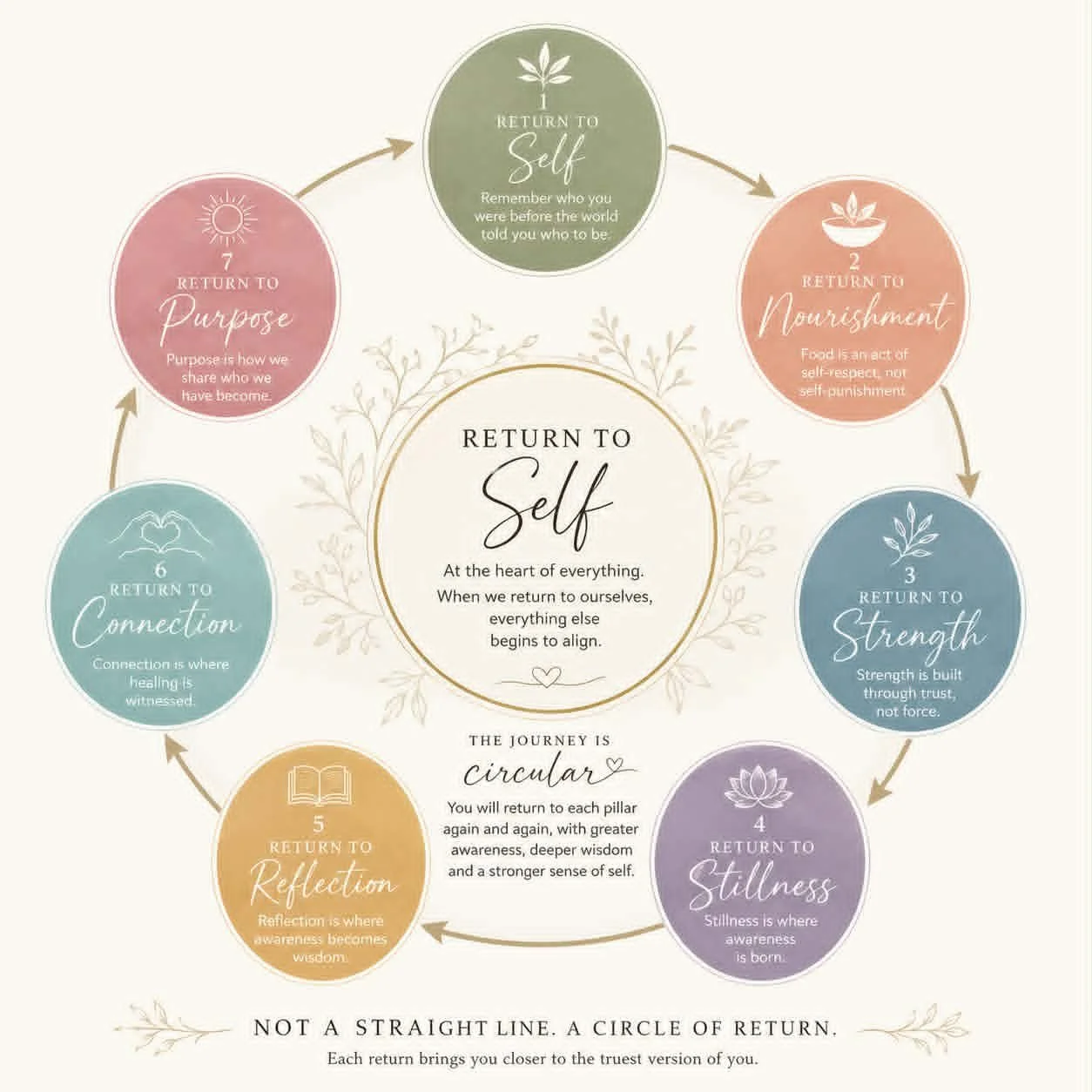
Why the Framework Works
Our lives aren't divided into neat little boxes.
Stress doesn't remain in the mind.
Grief doesn't stay in the heart.
Trauma doesn't only affect our memories.
Everything is connected.
Modern science continues to show us how deeply our nervous system, immune system, hormones, gut health, sleep, movement, relationships and emotional wellbeing influence one another.
Psychology teaches us that our beliefs shape our behaviours.
Physiology reminds us that our bodies respond to safety, nourishment and recovery.
Neuroscience demonstrates that our brains continue to adapt throughout life.
Ancient traditions have long understood the importance of presence, connection and balance.
Return to Self doesn't belong to one discipline.
It honours the wisdom found across many.
The Seven Pillars simply bring those ideas together in a way that can be lived every day.
Building Sustainable Change
Real change rarely happens through dramatic overhauls.
It grows through consistent, compassionate practice.
Each pillar invites us to pause.
To notice. To ask better questions.
To make one small adjustment.
Then another.
Healthy habits aren't built through guilt or perfection.
They're built through repetition, self-awareness and kindness.
The goal isn't to create a perfect life.
The goal is to create a life that supports who you truly are.
The Seven Pillars of The Return to Self
Seven pathways back to yourself
The Return to Self was born from a simple belief:
You are not broken. You are returning.
Throughout life, we experience seasons that shape us.
We grow.
We change.
We lose our way.
We begin again.
Sometimes life asks us to pause and listen more deeply. Sometimes it asks us to let go of who we thought we needed to be and reconnect with what has always been true.
The Seven Pillars are the foundation of The Return to Self.
They are not steps to complete.
They are not goals to achieve.
They are not another way to measure whether you are "doing life right."
They are places we return to again and again throughout our lives.
Places where we reconnect with ourselves.
Places where we nourish our bodies, strengthen our minds, quiet the noise, reflect on our experiences, deepen our connections and rediscover our purpose.
Because the journey home to yourself is not something you finish.
It is something you continue to return to.
1. Return to Self
Remember who you were before the world told you who to be.
This is where the journey begins.
Returning to yourself is not about becoming someone new.
It is about reconnecting with the person who has always been there beneath the roles, expectations and stories you have carried.
It is about remembering your values.
Your voice.
Your truth.
The parts of yourself that may have become quiet but were never lost.
You are not broken. You are returning.
2. Return to Nourishment
Caring for yourself through the way you choose to nourish your body.
Nourishment is an act of self-respect.
It is not about restriction, perfection or punishment.
It is about creating a relationship with food and wellbeing that feels supportive, sustainable and joyful.
It is found in the meals we prepare.
The choices we make.
The moments we slow down enough to care for ourselves.
Every meal is an opportunity to offer yourself love and care.
Every meal is an opportunity to care for yourself.
3. Return to Strength
Discovering strength through trust, not force.
Strength is not simply something we see.
It is something we feel.
It lives in our bodies.
In our resilience.
In our ability to begin again.
True strength is not about pushing harder or criticising ourselves into change.
It is about learning to trust our bodies, honour our experiences and celebrate what we are capable of.
Strong isn't a look. Strong is a feeling.
4. Return to Stillness
Creating space to listen.
In a world that constantly asks us to move faster, stillness becomes an act of returning.
Through breath.
Through nature.
Through mindfulness.
Through meditation.
Through quiet moments of reflection.
Stillness allows us to step away from the noise and reconnect with the wisdom within.
Because often, the answers we seek are not found by searching harder.
They are found when we become quiet enough to listen.
The answers are often found in the silence.
5. Return to Reflection
Awareness creates transformation.
Reflection allows us to understand ourselves with curiosity rather than judgement.
Through journalling.
Through gratitude.
Through honest conversations.
Through noticing our patterns and stories.
We begin to see ourselves more clearly.
Because what we understand, we can gently transform.
You cannot change what you refuse to see, but you can gently transform what you understand.
6. Return to Connection
Coming home through relationship.
We are not meant to walk through life alone.
Connection is one of our deepest human needs.
This pillar honours the relationships we create—with ourselves and with others.
It explores belonging.
Friendship.
Family.
Community.
Boundaries.
Compassion.
And the courage it takes to allow ourselves to be truly seen.
Because connection begins when we feel safe enough to be ourselves.
Connection begins with feeling safe enough to be yourself.
7. Return to Purpose
Living in alignment with what matters most.
Purpose is not about achieving more.
It is not about proving your worth.
It is about recognising that your life, your experiences and your story hold meaning.
Often, the very things we have walked through become the places where we can offer understanding, compassion and hope to others.
Your story matters.
Your life matters.
You matter.
Your life has meaning simply because you have lived it.
The Heart of The Return to Self
Everything created through The Return to Self—whether a reflection, recipe, journal prompt, conversation, gathering, retreat or experience—will always return to these seven pillars.
They are the threads that weave this philosophy together.
They remind us that wellbeing is not about becoming perfect.
It is about becoming present.
It is about creating a relationship with ourselves that is compassionate, honest and deeply connected.
The Return to Self is not the journey of becoming someone new.
It is the quiet, courageous journey of remembering the woman who was there before the world asked her to become someone else